Organization and Reorganization of Human Societies Eoc Review
Page Content
Overview
Modify management is the systematic approach and application of knowledge, tools and resource to deal with change. It involves defining and adopting corporate strategies, structures, procedures and technologies to handle changes in external weather and the business concern surroundings. Effective change management goes beyond project management and technical tasks undertaken to enact organizational changes and involves leading the "people side" of major modify inside an organization. The primary goal of alter management is to successfully implement new processes, products and business strategies while minimizing negative outcomes.
This article discusses the management of large organizational changes that may have far-reaching impacts on the system and its workforce, including the following topics:
- The nature and extent of organizational change.
- The business case for a systematic arroyo to change management.
- The roles of management and 60 minutes during major change initiatives.
- Steps to have in managing organizational alter.
- How to overcome common obstacles encountered during organizational alter.
- Legal and global considerations in managing change.
This article as well highlights some of the special issues and challenges in implementing sure types of major organizational modify, including mergers and acquisitions, downsizing, defalcation, concern closure, outsourcing, and changes inside the Hour function.
Groundwork
To keep pace in a constantly evolving business world, organizations often need to implement enterprisewide changes affecting their processes, products and people. Change is a fact of life in businesses today. It can be hard, and people oft resist it. Merely to develop an agile workplace culture, organizations should follow a systematic approach to managing major alter. Organizational development experts accept established approaches for successfully navigating through change. See How to Manage Alter.
Organizational leaders must place and respond quickly to market changes and unexpected challenges, but most are non in a position to create an agile culture. Yet agile leadership—from CEOs downwards to line-level managers—separates loftier-performing from lower-performing organizations. Companies that consistently outperform competitors in profitability, market place share, acquirement growth and client satisfaction reported much greater agility than lower performers. Run across Don't Just Adapt to Change—Pb It.
Business organization Case
The charge per unit of major organizational change has accelerated dramatically in this decade. Global research and informational company Gartner reports that the average organization has undergone five enterprise changes in the past three years and 73% of organizations wait more change initiatives in the next few years.1
As change initiatives accept become more frequent and widespread, the importance of managing individuals through change has gained credence. Major changes tin can impact organizations across all levels. Many corporate leaders have concluded that failing to manage employees through change can be plush: Employees who are dissatisfied with or upset by change are generally less productive.
An employer that is serious nearly change management should develop a communication programme, a road map for change sponsors, integrated training programs and a plan for dealing with resistance. MeetSHRM Foundation Report a Primer for Change Management.
HR should exist involved in major organizational changes from the commencement and can help by influencing the following:
- Improving employees' understanding of alter.
- Increasing communication between management and employees.
- Identifying and mitigating risks.
- Enhancing employee satisfaction.
- Boosting trust between management and employees.
- Improving employee skills and proficiency through modify-related training initiatives.
SeeHow Leaders Can Help Employees Take Technology Changes.
The Roles of Management and HR
Business managers who want to undertake major transformation to stay competitive must work with HR staff to gain employee acceptance and support.
Management's role
Having the correct leadership and buy-in from the executive team is critical to unifying the organisation behind a common strategic management.
Another cardinal is making certain all managers are equipped to jitney their straight reports toward delivery. One-on-one conversations help individual team members analyze how the change will impact them, make up one's mind their level of commitment and cull how they will deed. Questions managers should address with employees include:
- What is changing?
- Why is it changing?
- How will it affect your expanse?
- How volition it impact you straight?
EncounterChanging the Change Rules at Google.
Unfortunately, many managers are not practiced at alter direction. The lack of modify management skills amid managers tin make change initiatives difficult to achieve. A Towers Watson Change and Communication ROI Survey found that 87 per centum of employers train managers on effective alter management; nonetheless, only one-quarter of those employers plant the grooming to be effective.2 To increase managers' skills, HR should provide training that is tailored to the specific modify initiative and the competencies necessary to lead successful change. SeeLeadership Critical to System Change Efforts and Senior Leader Accountability: Critical to Successful Change.
60 minutes's role
HR can play a dual role in change management by initiating and leading the modify and by serving every bit a facilitator for changes that other leaders and departments initiated. See What is Hr'southward Part in Managing Modify? and Hr Tin can Better Employee Buy-In for Organizational Alter.
The HR department performs a variety of functions associated with the communication, implementation and tracking of major changes. Near normally, HR professionals assist employees by serving as a indicate of contact for questions and concerns and by explaining any affect on staffing. In addition, HR often coordinates meetings and communications most the change and related initiatives. Other common HR roles and responsibilities include:
- Providing initial employee communications about changes.
- Developing training programs.
- Preparing informational documents.
- Assessing readiness before the change.
- Analyzing potential impact.
HR can besides play a strategic role in change management by calculating the post-implementation return on investment by identifying key performance indicators (KPIs) to be measured and past tracking and communicating these results.
Past championing modify, Hr tin can assistance the organization increment buy-in, condolement and support for modify beyond departments, thereby increasing the success of alter initiatives. Run acrossManaging Organizational Modify with an HR Department of One.
Steps in the Alter Direction Process
Organizations should systematically prepare for and implement major organizational modify. John Kotter, a Harvard Business School professor, adult a well-known and widely adopted arroyo for managing organizational change. This approach, updated in Kotter'southward volume Accelerate, involves the post-obit eight stages:three
1. "Create a sense of urgency." Successful transformation efforts usually begin when leaders examine the market for changes that may pb to new competitive realities for the organization. These changes can stem from demographic shifts, social trends, new technology, marketplace or competitor changes, or new authorities regulations. The leaders should explain that a potential crisis or major opportunity is imminent, and they should encourage frank give-and-take throughout the organization. Creating a sense of urgency that the condition quo is no longer adequate is essential to gain the workforce'southward energetic cooperation.
2. "Build a guiding coalition." One time employees feel a sense of urgency, leaders should institute a grouping with enough ability to atomic number 82 the change. Members need substantial authority based on position, expertise, brownie and leadership, as well as effective management skills and proven leadership abilities. This coalition must learn to work together based on trust and fix a common goal. Many guiding coalitions build trust through offsite meetings, articulation activities and conversation.
3. "Form a strategic vision and initiatives." The guiding coalition should craft a clear vision for the future, motivate people to take advisable actions and coordinate their actions. An constructive vision is imaginable, desirable, viable, focused, flexible and catching, co-ordinate to Kotter. Creating an constructive vision takes time and can be a challenging process, only the end product provides a clear direction for the future.
iv. "Enlist a volunteer army." Once the guiding coalition has developed the vision, its members should provide extensive communications about how the modify volition improve the business and how those improvements will benefit employees. Key elements in effective communications include simplicity, use of examples, multiple forums, repetition, caption of apparent inconsistencies and two-way communication. The group should model the beliefs expected of employees.
5. "Enable activity by removing barriers." To empower workers to support change and human action on the vision, alter leaders should identify and remove obstacles. Four categories of important obstacles are:
- Formal structures that arrive difficult for employees to human action.
- A lack of needed skills.
- Personnel or information systems.
- Supervisors who discourage actions toward implementing the new vision.
six. "Generate short-term wins." Successful and enduring modify takes fourth dimension, which can exist discouraging to employees at all levels of the system. To maintain urgency, leaders should create conditions that support early successes and visible improvements. The key is to actively search for opportunities to score early achievements and to recognize and advantage those who made these accomplishments possible. Good short-term wins have unambiguous results, are visible to many people and are clearly related to the change try.
seven. "Sustain acceleration." Until major changes are embedded in an organization's civilization (which could take upwardly to a decade), they remain vulnerable to resistance and regression. It is important to utilise the early successes as a foundation for larger challenges and to revise all systems, structures and policies that exercise not fit the change vision. HR can consolidate gains by hiring, promoting and developing employees who can implement the transformation vision. Additionally, the change process can be reinvigorated with new project themes and change agents.
8. "Institute modify." The final phase in Kotter's model for successful modify is linking the changes to two key components of corporate culture—norms of grouping behavior and shared values.
Another model for organizational alter includes a four-stage alter management procedure:
- Define—Align expectations regarding the scope of the change likewise as timing and business affect.
- Programme—Empathise how the change volition touch on stakeholders and design a strategy to help them navigate it.
- Implement—Engage with leaders and assembly to execute the modify.
- Sustain—Work with leaders and employees to runway adoption and bulldoze lasting change.
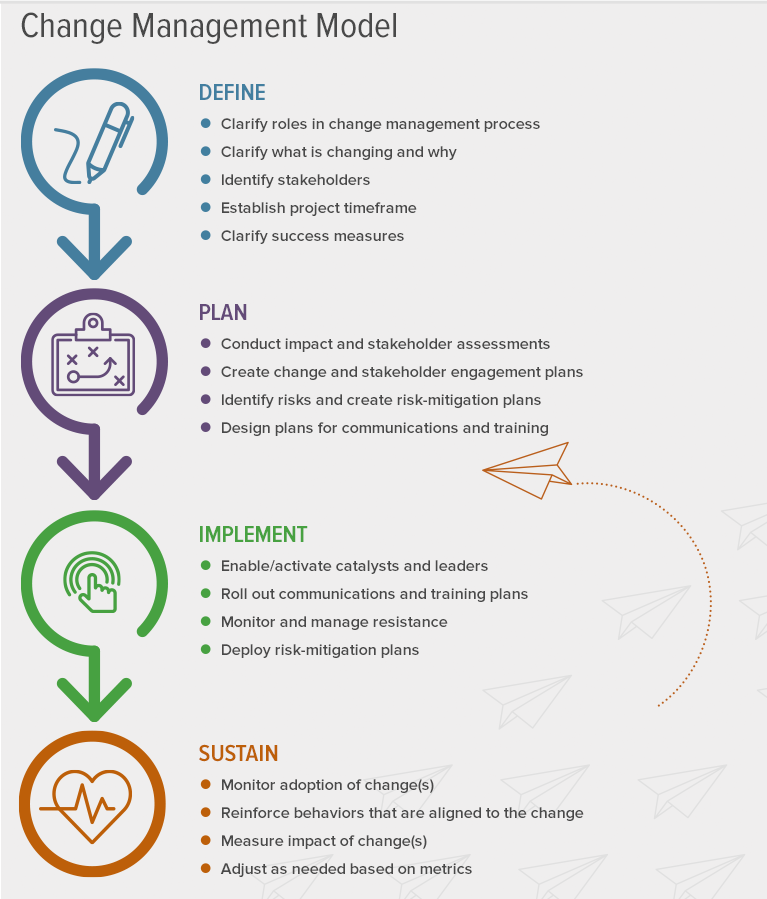
A large global retailer uses this model to increase the speed and affect of alter initiatives while reducing the downturn of performance, thereby achieving desired outcomes quicker.
Overcoming Common Obstacles Encountered in Implementing Change
Organizations tin can have a clear vision for changes and a technically and structurally sound foundation for making changes, but the initiatives can nonetheless flounder due to obstacles that arise. Employee resistance and advice breakdown are common obstacles faced during major organizational change. SeeHow to Avert Mutual Mistakes in Change Management.
Employee resistance
Successful change starts with individuals, and failure frequently occurs considering of homo nature and reluctance to change. Employees may also lack the specific behavioral traits needed to suit hands to changing circumstances, which could subtract employee appointment and effectiveness and put organizational productivity at adventure. How organizations treat workers during a alter initiative determines how successful the change—and the organization—volition exist.
There are six states of change readiness: indifference, rejection, dubiousness, neutrality, experimentation and commitment. Organizations about to commence on a transformation should evaluate workforce readiness with assessment instruments and leader self-evaluations to place the areas in which the most work is needed.
Leaders should have a solid strategy for dealing with change resistance. Some actions to build employee change readiness include:
- Developing and cascading potent senior sponsorship for people-focused work. In the absence of visible sponsorship, leaders should build alliances, encounter business organization needs and promote wins.
- Developing tools and data for front-line supervisors and managers. Organizations should involve them early—train them, prepare them and communicate regularly.
- Coaching employees to assist them suit and thrive during change.
- Rewarding desired behaviors and outcomes with both tangible and intangible rewards.
- Relying on insights from both those in the field and subject-matter experts.
SeeIs Change Stressing Your Workers? Turn to a Millennial and Wanted: Workers Who Can Adapt to Alter.
Communication breakdown
Sometimes decisions nearly major organizational changes are made at the elevation management level and and so trickle down to employees. Every bit a outcome, why and how the company is irresolute may be unclear. According to a Robert Half Direction Resources survey, poor advice commonly hinders organizational change-direction efforts, with 65 percent of managers surveyed indicating that clear and frequent communication is the most important attribute when leading through change.
To avoid this problem, Hour should be involved in change planning early to help motivate employees to participate. Effective communication promotes awareness and understanding of why the changes are necessary. Employers should communicate alter-related data to employees in multiple forms (e.k., e-mails, meetings, preparation sessions and press releases) and from multiple sources (e.yard., executive management, 60 minutes and other departments). Come acrossWhy United Airlines' Lottery-Based Bonus Idea Cruel Flat.
To avert communication breakdowns, alter leaders and Hr professionals should be aware of five modify communication methodologies—from those that provide the greatest amount of information to those that provide the to the lowest degree:
- "Spray and pray." Managers shower employees with information, hoping they tin sort significant from insignificant. The theory is that more information equates to better communication and determination-making.
- "Tell and sell." Managers communicate a more limited ready of messages, starting with key problems, and and then sell employees on the wisdom of their approach. Employees are passive receivers, and feedback is not necessary.
- "Underscore and explore." Managers develop a few core messages clearly linked to organizational success, and employees explore implications in a disciplined way. Managers mind for potential misunderstandings and obstacles. This strategy is mostly the near constructive.
- "Identify and respond." Executives identify and respond to central employee concerns. This strategy emphasizes listening to employees; they set the agenda, while executives answer to rumors and innuendoes.
- "Withhold and uphold." Executives withhold information until necessary; when confronted by rumors, they uphold the party line. Secrecy and control are implicit. The assumption is that employees are not sophisticated plenty to grasp the big picture.
Experts estimate that effective communication strategies tin can double employees' acceptance of change. Notwithstanding, often companies focus solely on tactics such equally channels, messages and timing while failing to practise a contextual analysis and consider the audience. Some of the specific advice pitfalls and possible remedies for them are the post-obit:
- The wrong messengers are used. Studies accept constitute that employees tend to trust information from managers. Understanding the system's civilisation will dictate who is the best messenger for change—the director, the senior executive team or HR.
- The modify is also sudden. Leaders and managers demand to prepare employees for change, permit time for the bulletin to sink in and give them an opportunity to provide feedback earlier a change is initiated.
- Advice is not aligned with business realities. Messages should be honest and include the reasons behind the change and the projected outcomes.
- Advice is besides narrow. If the communication focuses too much on particular and technicalities and does not link change to the organization's goals, it will not resonate with employees.
Executive leaders and HR professionals must exist great communicators during change. They should curl out a articulate, universal, consistent message to everyone in the organization at the same fourth dimension, fifty-fifty beyond multiple sites and locations. Managers should and then meet both with their teams and one on i with each team member. See Say What?! Honing Communication Skills at the Top.
Leaders should explicate the alter and why it is needed, be truthful about its benefits and challenges, listen and respond to employees' reactions and implications, and then ask for and piece of work to achieve individuals' delivery. MeetKeep information technology Clear: Three Means to Assist Communicate Change in Your Organization and Managing Organizational Communication.
Other obstacles
Employee resistance and communication breakdowns are not the merely barriers that stand up in the way of successful modify efforts. Other common obstacles include:
- Insufficient fourth dimension devoted to training about the change.
- Staff turnover during the transition.
- Excessive change costs.
- An unrealistic change implementation timeline.
- Insufficient employee participation in voluntary training.
- Software/hardware malfunctions.
- Downturn in the market or the economic system.
Run acrossHow Leaders Can Assist Employees Accept Engineering Changes.
Change management experts have suggested that unsuccessful alter initiatives are often characterized by the following:
- Beingness too top-downwards. Executives relate their vision of what the stop result of the modify initiative should be, only practice not give direction or communication on how the managers should make the change happen.
- Existence likewise "big motion-picture show." The organisation'south leaders have a vision of the change but no idea of how that alter will affect the individuals who work at that place.
- Beingness as well linear. Managers piece of work the project plan from start to finish without making even necessary adjustments.
- Being as well insular. Most organizations do not seek outside help with change initiatives, but businesses may need objective external input or aid to attain major changes.
Successful modify management must be well-planned, well-timed and well-integrated. Other critical success factors include a structured, proactive approach that encompasses advice, a road map for the sponsors of the change, training programs that go along with the overall project and a plan for dealing with resistance. Alter leaders demand to be agile and visible in sponsoring the change, not only at the commencement only also throughout the process. Turning their attending to something else tin can send employees the wrong message—that leaders are no longer interested. SeeExecutive Briefing: How to Gainsay Change Fatigue and Dan Heath: Observe the 'Bright Spots' to Generate Alter.
Managing Varied Types of Major Organizational Modify
Organizational change comes in many forms. It may focus on creating new systems and procedures; introducing new technologies; or adding, eliminating or rebranding products and services. Other transformations stem from the appointment of a new leader or major staffing changes. Still other changes, such as downsizing or layoffs, defalcation, mergers and acquisitions, or endmost a business concern operation, affect business concern units or the entire organisation. Some changes are internal to the HR function.
In addition to the general framework for managing alter, change leaders and Hour professionals should also exist aware of considerations relating to the particular type of alter being made. The subsections below highlight some of the special problems and 60 minutes challenges.
Mergers and acquisitions
A merger is mostly divers as the joining of ii or more organizations nether one common buying and management structure. An acquisition is the process of one corporate entity acquiring command of another by purchase, stock swap or some other method. Nearly two-thirds of all mergers and acquisitions (M&As) neglect to achieve their predictable strategic and financial objectives. This rate of failure is often attributed to HR-related factors, such equally incompatible cultures, direction styles, poor motivation, loss of fundamental talent, lack of communication, diminished trust and dubiety of long-term goals.
HR professionals face up several challenges during M&As, including the post-obit:
- Attempting to maintain an internal condition quo or to result change—either to facilitate or thwart (in the instance of a hostile takeover) a possible merger or acquisition, as instructed by upper management.
- Communicating with employees at every pace in the Yard&A procedure with appropriate levels of disclosure and secrecy.
- Devising ways to meld the two organizations most effectively, efficiently and humanely for the diverse stakeholders.
- Dealing with the reality that M&Every bit unremarkably consequence in layoffs of superfluous employees. This process entails analogous separation and severance pay issues betwixt the combining organizations.
- Addressing the ethical dilemmas involved, such equally when an Hr professional may be required to eliminate his or her ain position or that of a co-worker or an HR counterpart in the combined organization.
Downsizing
Successfully implementing a layoff or reduction in force (RIF) is one of the more than difficult change initiatives an HR professional may face. Tasks HR professionals volition demand to undertake include:
- Planning thoroughly. Each pace in the process requires careful planning, because alternatives, selecting employees to be laid off, communicating the layoff decision, handling layoff documentation and dealing with post-layoff considerations.
- Applying diverseness concepts. 60 minutes should form a diverse team to ascertain layoff criteria and make layoff selections.
- Addressing the needs of the laid-off. This step involves reviewing severance policies, outplacement benefits, unemployment eligibility and reference policies.
- Dealing with the emotional impact. Hour professionals should understand and prepare for the emotional impact of layoffs on the downsized employees and their families, on the managers making layoff decisions, on other HR professionals involved, and on remaining employees and managers working with the mail service-layoff workforce. In some situations, an Hour professional person may even be responsible for implementing his or her own layoff, a case calling for the utmost in professional beliefs.
- Managing the post-layoff workforce.
Come acrossManaging Downsizing by Ways of Layoffs and Drive Squad Functioning Using Organizational Transformation
Bankruptcy
Filing for a concern defalcation and successfully emerging from the process is generally a complex and difficult time for all parties. HR may have to cutting staff, reduce benefits, alter piece of work rules or utilise a combination of such actions. A major strategic concern during a Chapter 11 bankruptcy is retaining key personnel.
Compassion, frequent communication and expeditious decision-making will assist reduce the stress an organization's employees are likely to experience during this difficult organizational change. Showing genuine respect for people and treating them with honesty, dignity and fairness—even as difficult decisions are existence made about pay, benefits and job reductions—will drive the success or failure of an organization post-defalcation. SeeManaging Human being Resource for a Company in Bankruptcy.
Closing a business operation
Businesses brand the difficult conclusion to close all or office of their operations for many reasons, including economic recession, market decline, bankruptcy, sale, a realignment of operations, downsizing, reorganization, outsourcing or loss of contracts.
HR professionals will play an integral function during such business closures, from developing the plan for the closure through the final stages of shutdown. Some of Hour'south major responsibilities during this type of organizational alter are listed below:
- Following facility-closing notification laws. HR must decide whether and to what extent the business must comply with notification requirements nether federal or state laws for mass layoff and facility closings. HR will too atomic number 82 the annunciation process and participate in all aspects of employee communications, which may include all-employee meetings, written announcements and media interviews.
- Announcing the closure news. HR has an important role to play in anticipating and responding to workforce reactions by having as much data and resource on hand every bit possible. To avert hostilities or other subversive behavior, 60 minutes should consider using an employee aid program or an outplacement firm.
- Providing employee benefits information. Afterwards the daze of the announcement subsides, the most frequently asked questions involve benefits, including unemployment compensation, health care continuation, pension plan problems, and retirement program distributions and rollovers.
- Coordinating outplacement services. Offering outplacement services for departing employees may enable concern owners and managers to provide much-needed support and protect the organization's reputation. If financially feasible, the organization may offer departing employees outplacement services from a private outplacement consulting firm or, in some states, a state agency.
- Negotiating with unions. In unionized facilities, employers have a duty to bargain almost the effects of a business closure decision. These negotiations typically involve assistance benefits, seniority issues, pension programme bug and employment opportunities at facilities not affected by the closure.
- Costing the closure. Anticipating the costs of a business closure is critical from an early on phase of the procedure and will autumn heavily on Hr. This procedure involves assessing the toll of winding downward employee benefits, aid benefits, payroll and administrative costs, severance payments, matrimony demands, unresolved employee claims or charges, security precautions, and any closing notification penalties.
- Disposing of company holding. HR should know the organisation'southward policy for disposal of visitor property and respond to employees' requests for office furniture, equipment, mechanism and other tangible business assets. If the business does not sell or transfer assets or is not in debt to creditors, HR may help decide whether to requite items to employees, community groups, schools or other potential recipients.
- Complying with legal requirements. Numerous legal issues environs the closing of a business. Depending on the number of employees and the employer's commitments to employee benefits programs, legal compliance may crave following endmost-notification requirements, sending out COBRA notices and termination letters, issuing final paychecks, making any required severance payments and communicating unemployment bounty. Hr must know how to comply with the laws and avoid litigation risks.
Outsourcing
For several reasons, including cost savings and freeing staff to focus on more than strategic efforts, an arrangement may determine to outsource HR or other business functions. Outsourcing is a contractual understanding betwixt an employer and a 3rd-party provider whereby the employer transfers the management of and responsibility for certain organizational functions to the external provider. Many types of outsourcing options are bachelor to employers, from outsourcing one aspect of a unmarried function to outsourcing an entire functional section. This change tin can have a like impact on employees as downsizing or endmost a department.
When deciding whether to outsource, an organization should carefully consider questions nigh its needs in a particular functional area, electric current processes, business programme and outsourcing options, including:
- Does the situation merit outsourcing?
- Is the section providing first-class service with existing staff and processes? Is it coming together the organization's needs?
- Tin the affected department handle outsourcing without disrupting operations?
- Will the CEO and top direction team back up and pay for an exterior vendor?
- How might an outsourcing arrangement fall short of expectations? How can such risks be mitigated?
During an Hr outsourcing process, HR professionals may exist asked to place solutions to guide organizations through vendor option and management of the outsourcing relationship. MeetOutsourcing the Hr Function.
Changes within HR
Hr professionals often assist other parts of the organization respond to change, only what happens when the HR department becomes the epicenter of change? These kinds of transformations, such every bit moving to a shared services model, integrating with another HR function following a merger or delivering new services to new clients, can be more difficult for Hour professionals to manage than other types of organizational changes.
During major changes within the HR function, HR should do the following:
- Pb by example. Practise exactly what HR asks other leaders and managers to do during major modify initiatives.
- Remember that Hour professionals' responsibilities never cease. The HR department must continue to serve employees while contending with the discomfort, confusion and demands that department-specific change creates.
- Proceed in listen that few organizational changes occur in isolation. If senior leaders determine to implement an Hour shared services model, for instance, the information engineering science, finance and procurement functions as well could move to a like model or initiating efficiency projects.
- Measure out the degree to which HR staff is prepared to modify before plunging into the alter. HR leaders should assess staff readiness and appointment through interviews and surveys. After evaluating the results, they should make necessary adjustments in staff readiness and engagement levels before proceeding.
- Realize that most Hour transformations crave fresh, or refreshed, talent. Hr leaders can fire and rent, or they tin can retrain and develop.
Legal Issues
In addition to managing the "people side" of organizational change initiatives, HR professionals should go along leadership informed of whatever applicative employment laws and the potential legal implications of various types of modify. Typically, 60 minutes will be responsible, in consultation with legal counsel, for ensuring compliance with pertinent federal, country, local and international employment laws and regulations.
Legal compliance requirements may vary considerably based on the nature of the alter initiative, the location(s) and size of the organization, whether the employer is unionized, and other factors. Federal laws that may apply to particular organizational change initiatives include:
- Title VII of the Civil Rights Act of 1964.
- Age Discrimination in Employment Act (ADEA).
- Americans with Disabilities Human activity (ADA).
- National Labor Relations Act (NLRA).
- Worker Adjustment and Retraining Notification Human activity (WARN) of 1988.
- Employee Retirement Income Security Act (ERISA).
- Health Insurance Portability and Accountability Act (HIPAA) of 1996.
- Consolidated Motorbus Budget Reconciliation Act (COBRA).
SeeFederal Statutes, Regulations and Guidance.
Hr professionals may also be responsible for negotiating contracts with unions, service providers or vendors. In such cases, they need to be familiar with central contract terms and issues and exist able to correspond the system'south interests finer in contract negotiations and direction. MeetConducting Effective Business Negotiations.
Global Issues
Significant organizational changes can create ongoing conflict between two locations in the same country. Simply conflict is more probable to occur, and is harder to address, when differences in language, fourth dimension zones, institutions and business practices exist. Co-ordinate to research conducted by the Economist Intelligence Unit, companies will go on to go larger and more than global, treatment operations in more than countries than they practice today.4
Culturally based assumptions about customer needs, infrastructure, competitive threats and other factors make it more hard to notice common ground during a cross-cultural change initiative. What differentiates an organization'due south products or services in one land may not exist the same elsewhere, and the strengths that it has in its home market may non be easily replicated in other countries.
Common bug in cross-cultural modify initiatives include:
- Lack of a partnership approach. Information technology is natural for an organization to consider its home market and its largest customers when planning change efforts. Even so, those voices can easily drown out the needs of employees or clients in distant markets, including those that could accept high growth potential. By partnering with all employees and clients from the beginning and because time to come potential for revenue, profit and growth, an system can build an approach to change that integrates the patterns of by successes with future directions.
- Misreading similarities and differences in markets. Multinational organizations might project solutions suitable for i state onto some other country or presume that customers abroad desire to behave "more than like usa." To make matters more complicated, foreign products may have considerable appeal in some markets just frequently for reasons that merely make sense in the local context. Companies may expect the same competitive landscape, all the same the largest competitive threats may come from companies that are unknown back at headquarters.
- Not enough accountability. Establishing accountability at the local level is difficult when employees lack a sense of ownership for a new initiative. This state of affairs tin be exacerbated past the typical matrix organizational structure at many global companies. Employees who written report into both a global business unit and a local direction structure frequently pay the closest attention to the managers they run into every day who are nigh likely to bear on their futures.
Leaders of global change initiatives should consider these potential problems and programme to accost them in advance. They volition be far more likely to avoid alter-related pitfalls; achieve their objectives; and build business partnerships characterized by mutual learning and superior business concern results.
Endnotes
1Gartner. (2018). Modify Direction. Retrieved from https://www.gartner.com/en/insights/change-management
2Willis Towers Watson. (2013, August 29). Only one-quarter of employers are sustaining gains from alter management initiatives, Towers Watson survey finds. Retrieved from https://www.towerswatson.com/en/Press/2013/08/Merely-1-Quarter-of-Employers-Are-Sustaining-Gains-From-Change-Direction
3Kotter, John. (2014). Accelerate: Building strategic agility for a faster-moving world. Boston, MA: Harvard Business Review Press.
4Economist Intelligence Unit. (2010). Global firms in 2020: The next decade of change for organisations and workers. Retrieved from https://www.shrm.org/hr-today/trends-and-forecasting/inquiry-and-surveys/Documents/ten-Economist%20Research%xx-%20Global%20Firms%20in%202020.pdf
Source: https://shrm.org/ResourcesAndTools/tools-and-samples/toolkits/Pages/managingorganizationalchange.aspx
0 Response to "Organization and Reorganization of Human Societies Eoc Review"
Post a Comment