Sculpted Bust of a Woman Allegorical Pa Academy of Fine Arts

G-109. William Rush Etching His Allegorical Figure of the Schuylkill River (1876–77), Oil on canvas, 51.one cm x 66.three cm (20-1/viii in x 26-i/8 in), Philadelphia Museum of Art.
William Rush and His Model is the collective name given to several paintings by Thomas Eakins, one set from 1876–77 and the other from 1908. These works draw the American forest sculptor William Blitz in 1808, carving his statue Water Nymph and Bittern for a fountain at Philadelphia'southward first waterworks. The water nymph is an allegorical effigy representing the Schuylkill River, which provided the city'due south drinking h2o, and on her shoulder is a bittern, a native waterbird related to the heron. Hence, these Eakins works are also known as William Rush Carving His Emblematic Effigy of the Schuylkill River .
Nymph and Bittern [edit]

Philadelphia'south first waterworks was located at Centre Square, now the site of Philadelphia City Hall. Steam engines drew drinking h2o from the Schuylkill River and pumped it upwards to tanks in the engine house belfry, from which it was distributed by gravity through surreptitious mains to the city. Rush, a carver of ship figureheads, was commissioned in 1808 to cleave an emblematic statue to be the centerpiece of an ornamental fountain. His pine statue was painted white to imitate marble, and its h2o jet gushed from the mouth of the bittern held atop the nymph's shoulder. Art historian Elizabeth Milroy notes that the nymph's pose recalls the Venus de' Medici, a copy of which was owned by a Philadelphia painter. Local legend tells that the girl of a Watering Commission member posed as Rush's model.[1] When the Middle Foursquare waterworks was demolished in 1829, the statue was relocated to a fountain at the nearby Fairmount Waterworks.[two]
Following more than sixty years of exposure to water and the elements, Nymph and Bittern was stripped of its white paint in 1872, and a bronze copy was cast. The copy became the centerpiece of a new fountain at Fairmount, and the rotting original was placed in storage.[3]
Eakins and Rush [edit]

The bronze copy of Nymph and Bittern (bandage 1872), in the 1930s.
Eakins's interest in William Blitz originated from a desire to restore Rush'south name to prominence in the history of American art. Eakins taught at the Pennsylvania Academy of the Fine Arts, of which Rush had been a founder. Eakins was a potent laic in teaching human being anatomy, and insisted that his students study from nude models. Since it is unlikely that Rush had employed a nude model for his sculpture of a draped water nymph,[iv] the painting may exist viewed as Eakins's sit-in of the importance of studying anatomy from nudes.
Eakins was able to written report both versions of the statue, and his notes document the deteriorated condition of the wooden original. Only its head survives, in the collection of the Pennsylvania Academy of the Fine Arts.[5] The 1872 bronze copy is in the collection of the Philadelphia Museum of Art.
1876–77 versions [edit]

Key to G-109. Fatigued past Eakins for an 1881 exhibition catalogue. Hirshhorn Museum.
Equally part of his process of creating the painting, Eakins carved wax studies of the nymph, her head, Rush'due south head, the nude model, and the other Rush sculptures depicted. Five of the six wax studies survive, in the collection of the Philadelphia Museum of Fine art (PMA).[half dozen]
Studies [edit]
At Yale University Art Gallery is what appears to exist an abandoned version of the painting (1000-111), presumed to pre-date the finished version at PMA. This is sometimes called a study, but it is almost the same size as the finished version, contains the same figures (although the chaperone faces a different direction), and was never displayed during Eakins's lifetime.
At the Farnsworth Art Museum in Rockland, Maine, is an oil study for some other composition (G-110). The model stands on a higher pedestal, and the chaperone has been placed between the model and Rush. Judging from a photo in a 1938 auction catalogue, G-110 seems to be cut down from a larger study.[7]
Finished version [edit]
The finished version of William Blitz and His Model (1000-109, Philadelphia Museum of Art) has the model slightly rotated, and the chaperone to the model'due south right, facing Rush. In the foreground, between Rush and the model, stands a chair conspicuously displaying the model's wearing apparel. Blitz's life-sized figure of George Washington (1815), and his Allegorical Effigy of The Waterworks (1825)—a reclining female effigy manipulating a waterwheel—are visible in the background. Although the painting is historically inaccurate—Rush carved H2o Nymph and Bittern in 1808, and the other statues years later—Eakins's intent seems to have been to present a survey of the sculptor's whole career.
The painting was first exhibited in January 1878 at the Boston Fine art Club, and later that year at the Order of American Artists in New York.[4] It immediately sparked controversy with one New York reviewer writing, "What ruins the picture is much less the want of beauty in the model ... than the presence in the foreground of the clothes of that young adult female, cast carelessly over a chair. This gives the shock which makes one think about the nudity—and at once the picture becomes improper."[8]
Sketches and preparatory studies [edit]
-
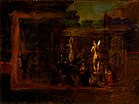
Thou-110. Compositional study (circa 1877), Farnsworth Art Museum. This seems to be cut down from a larger written report.
1908 versions [edit]
For unspecified reasons—possibly related to the statue'south approaching centennial—Eakins returned to this subject field in 1908. His beginning 1908 version (G-445, now in the Brooklyn Museum) is similar to the PMA version, however, Rush and his statue have been moved to the far right, the chaperone is to the model's left, facing the viewer, and the pile of the model'south apparel has been eliminated. This is the to the lowest degree successful composition, with fiddling visual connectedness between Rush and the model.
The 2d 1908 version (G-451, in the Honolulu Museum of Fine art) shows a frontal view of the nude model descending the platform. She is neither idealized nor sentimentalized.[9] Rush is now out of the shadows and holding the model's mitt as if helping a yard lady descend from a carriage.[ix] The chaperone and groundwork sculptures are omitted from this version. The figure of Blitz may be a cocky-portrait by Eakins.[10]
Preparatory studies [edit]
-

K-449. Study of Rush for G-445 (1908), private collection.
References [edit]
- Ellis, George R., Honolulu Academy of Arts, Selected Works, Honolulu, Honolulu Academy of Arts, 1990, 227.
- Ellis, George R. and Marcia Morse, A Hawaii Treasury, Masterpieces from the Honolulu University of Arts, Tokyo, Asahi Shimbun, 2000, 110 & 211–ii.
- Johnson, Lincoln F., The Commencement of Modernism, Honolulu Academy of Arts Journal, Vol. 3, 1978, 17–23.
- Milroy, Elizabeth, The Filigree and the River: Philadelphia's Greenish Places, 1682–1876. University Park. The Pennsylvania State University Press, 2016.
- Philadelphia Museum of Art, Handbook of the Collections, Philadelphia, Philadelphia Museum of Art, 1995, 287.
- Sewell, Darrel (Ed.), Thomas Eakins. Yale University Press, 2001, 332. ISBN 0-300-09111-7
Footnotes [edit]
- ^ Milroy, 2016, p. 159.
- ^ Milroy, 2016, p. 189.
- ^ William Rush, American Sculptor, exhibition catalogue, Pennsylvania Academy of the Fine Arts, 1982, pp. 114–17.
- ^ a b Philadelphia Museum of Art, 1995, 287
- ^ Caput of the Nymph, from Pennsylvania Academy of the Fine Arts.
- ^ Susan James-Gadzinzki and Mary Mullen Cunningham, American Sculpture in the Museum of American Art of the Pennsylvania University of the Fine Arts, University of Washington Printing, 1997, pp. 90–93.
- ^ 1938 sale catalogue photo from SIRIS.
- ^ Sewell, 2001, p. 45.
- ^ a b Johnson, 1978, p. 21.
- ^ Ellis, 2000, p. 212.
- ^ The Model from Crystal Bridges Museum of American Art.
Source: https://en.wikipedia.org/wiki/William_Rush_and_His_Model
0 Response to "Sculpted Bust of a Woman Allegorical Pa Academy of Fine Arts"
Post a Comment