Barbie Dolls That Have Their Own Babies That Give Birth to Them but Are Aloe Really Low Prices
Photographs past Kenji Aoki for Time
Inside the biggest alter in barbie's 57-year history–and what it says near American beauty ideals
Part i
Barbie'due south clothes won't fit.
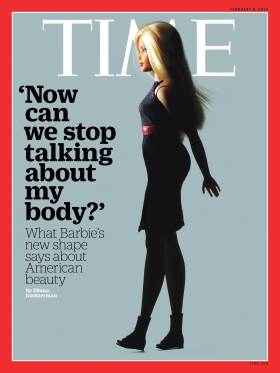
I'm sitting in a vivid pink room at Mattel'southward headquarters in El Segundo, Calif., playing with a Barbie that only xx people in the world know exists. Her creation has been kept so surreptitious that the designers code-named the endeavor Project Dawn so that even their spouses wouldn't be tipped off to her existence.
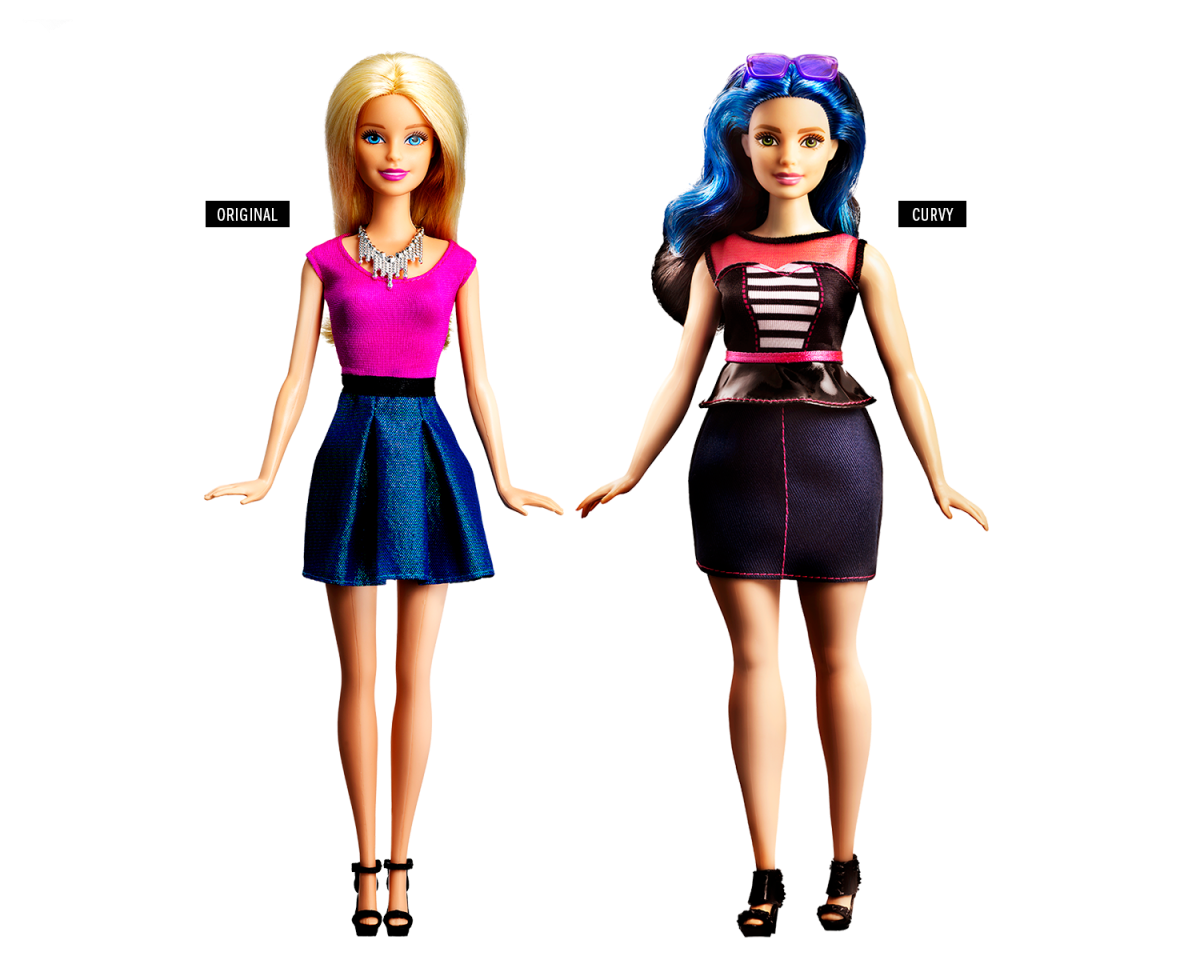
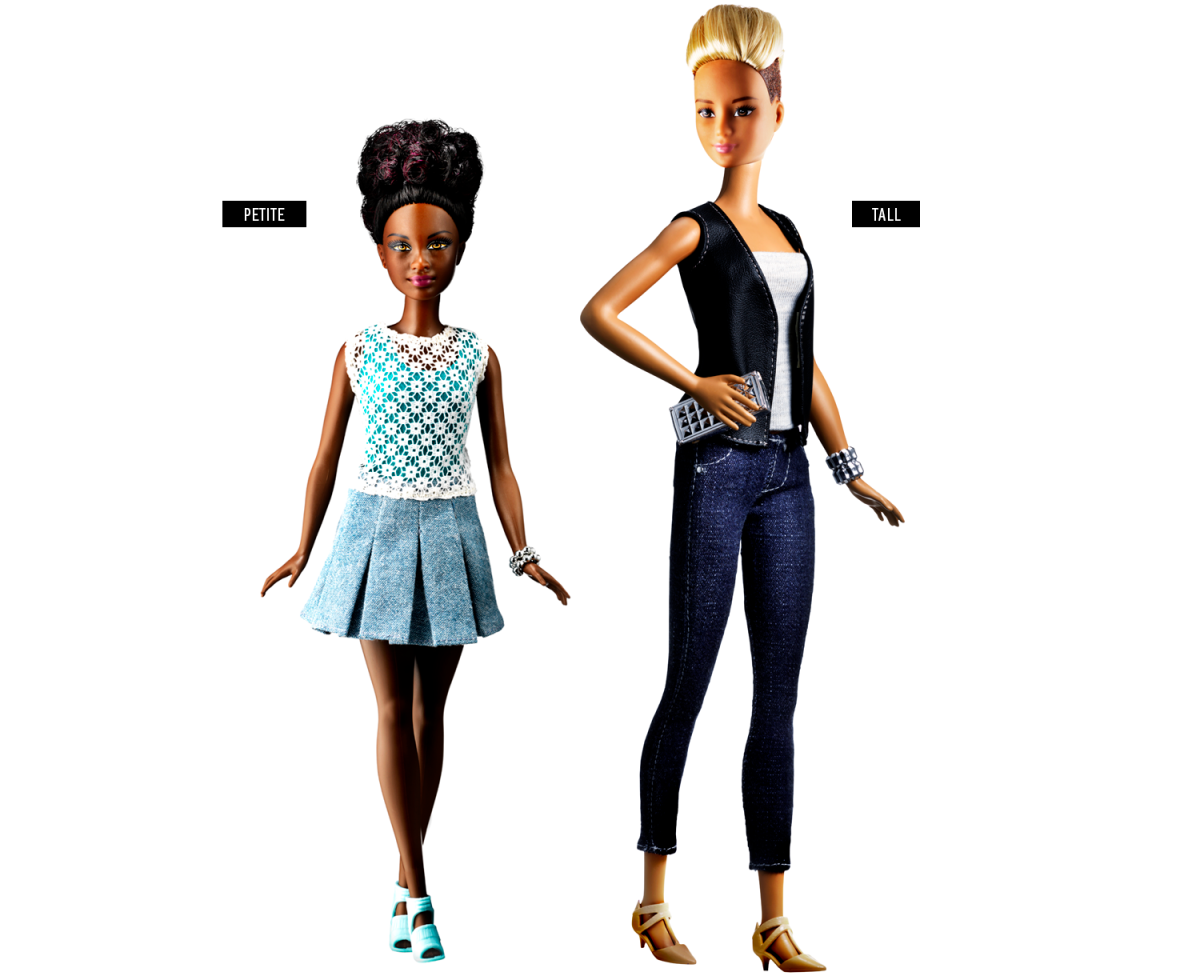
Like every girl who has ever played with the most pop toy in history, I yank her wearing apparel off and endeavor to put on a new dress. It's a blue summery apron, cinched tightly at the waist with a blackness ribbon. I try to tug it over her head, but the waistline gets stuck at her shoulders, her blond mane peeking out from the neckline. "Attempt going feet starting time," the pb designer suggests, and I practise. No good. Her plump bottom gets stuck in the aforementioned spot. Aye, plump. Barbie'due south got a new body. Three new bodies, really: petite, tall and curvy, in Mattel'southward exhaustively debated lexicon, and beginning Jan. 28 they volition exist sold alongside the original busty, thin-waisted form on Barbie.com. They'll all exist called Barbie, but it's the curvy one—with meat on her thighs and a protruding tummy and behind—that marks the virtually startling alter to the nearly infamous body in the world.
It'south a massive risk for Mattel. Barbie is more than just a doll. The brand does $i billion in sales across more than than 150 countries annually, and 92% of American girls ages iii to 12 have owned a Barbie, thanks in part to her affordable $10 price tag. She's been the global symbol of a certain kind of American beauty for generations, with make recognition that's up there with Mickey Mouse. Thousand.G. Lord, a Barbie biographer, one time said she was designed "to teach women what—for better or worse—is expected of them in society."
The company hopes that the new dolls, with their diverse trunk types, forth with the new skin tones and pilus textures introduced last yr, will more than closely reflect their immature owners' world. But the initiative could also backfire—if it's not too late birthday. Calculation 3 new torso types at present is sure to irritate someone: merely picking out the terms petite, tall and curvy, and translating them into dozens of languages without causing offense, took months. And similar me, girls will strip curvy Barbie and effort to put original Barbie's clothes on her or bandy the skirts of petite and tall. Not everything volition Velcro close. Fits will be thrown, exasperated moms will call Mattel. The visitor is setting up a separate help line just to bargain with Project Dawn complaints.
Only staying the course was not an selection. Barbie sales plummeted xx% from 2012 to 2014 and continued to fall last year. A line of toys designed to teach girls to build, Lego Friends, helped boost Lego above Mattel as the biggest toy company in the earth in 2014. Then Hasbro won the Disney Princess concern away from Mattel, just equally Elsa from the moving-picture show Frozen dethroned Barbie as the near pop daughter's toy. The estimated revenue loss to Mattel from Elsa and the other Disney Princesses is $500 million.
Meanwhile, American beauty ideals have evolved: the curvaceous bodies of Kim Kardashian West, Beyoncé and Christina Hendricks accept become iconic, while millennial feminist leaders like Lena Dunham are deliberately baring their un-Barbie-similar figures onscreen, fueling a motion that promotes trunk credence. In this environs, a new generation of mothers favor what they perceive as more empowering toys for their daughters. Elsa might be just as blond and waif-thin every bit Barbie, just she comes with a backstory of strength and sisterhood. "The millennial mom is a small part of our consumer base of operations," concedes Evelyn Mazzocco, head of the Barbie brand, "merely nosotros recognize she's the future."
Part 2
The lath behind Mazzocco's desk is filled with words like out of touch on, materialistic, not diverse.
She tacked them up shortly after she took over Barbie in 2014, part of a massive shake-up at Mattel during which president and COO Richard Dickson put people with creative backgrounds at the head of several brands, hoping they would come up upward with more than-innovative solutions to Mattel's sinking sales. The first affair Mazzocco did in that role was survey Barbie's haters.
"I wanted to remind myself every fourth dimension I came to work about the reality of what is going on with the brand," says Mazzocco, who has three daughters whom she uses every bit her "own picayune focus grouping." Not that she needed the reminder: she routinely receives hate postal service and even expiry threats over Barbie's torso.
Barbie has courted controversy since her birth. Her creator, Ruth Handler, based Barbie's torso on a High german doll called Lilli, a prostitute gag gift handed out at available parties. Her proportions were designed appropriately. When Handler introduced Barbie (named after her girl Barbara) in 1959 at the New York Toy Fair, her male person competitors laughed her out of the room: nobody, they insisted, would want to play with a doll with breasts.
Yet, Barbie's sales took off, merely by 1963 women were protesting the same body men had ridiculed. That year, a teen Barbie was sold with a diet volume that recommended just, "Don't eat." When a Barbie with pre-programmed phrases uttered, "Math class is tough," a group chosen the Barbie Liberation Organization said the doll taught girls that information technology was more important to be pretty than smart. They switched out Barbie's vox box with that of GI Joe so that the blonde cried, "Vengeance is mine," while the macho warrior enthused, "Permit's programme our dream wedding."
Mattel argues that the criticism was misplaced—that Barbie was a businesswoman in 1963, an astronaut in 1965 and a surgeon in 1973 when 9% of all doctors were women. "Our brand represents female empowerment," argues Dickson. "It's well-nigh choices. Barbie had careers at a time when women were restricted to being merely housewives. Ironically, our critics are the very people who should encompass united states."
Mattel has also long claimed that Barbie has no influence on girls' body image, pointing to whisper-thin models and even moms every bit the source of the dissatisfaction that too many young girls feel virtually their bodies. A scattering of studies, however, suggest that Barbie does have at to the lowest degree some influence on what girls run into every bit the platonic body. The almost compelling, a 2006 study published in the journal Developmental Psychology, plant that girls exposed to Barbie at a young age expressed greater business with being thin, compared with those exposed to other dolls.
Simply it was merely when moms started voting with their dollars that Mattel had to reassess these criticisms. In the mid-2000s Barbie faced her first serious competition after years of maintaining about 90% market share of the doll sector. Bratz, the edgy, problems-eyed dolls with their own smartphones and lip gloss, were "eating Barbie's luncheon in the older-girl demographic, and Disney Princess was chomping abroad at the younger-girl demographic," explains Dickson. "Barbie was having an identity crisis."
At first, this wasn't a major trouble for Mattel. Dickson was brought in in 2000 to aggrandize the Barbie brand from dolls to wearing apparel, Tv set shows and gaming. That's when Barbie got her ain interactive website. (She also has her own prove that streams on Netflix.) The Barbie make's sales went upwards even as the doll's sales sank. And Mattel as a whole prospered. The company was producing the Disney Princess dolls through a licensing bargain, and to gainsay the Bratz trouble, it created its ain line of cutting-edge dolls, Monster High.
But in 2012, Barbie global sales dropped 3%. They dropped another half-dozen% in 2013 and 16% in 2014. And the potency of Frozen's Elsa signals more than trouble ahead. Even two years later the picture show'south release, the allure of Frozen hasn't abated. At a Los Angeles Target, I locate Barbie in the toy aisle, beaming down at me from her dream business firm (pinkish convertible sold separately). On the next shelf over sits Elsa in a box that invites you to printing a button to hear her sing. I press. Every bit the doll begins to chugalug out the girl-ability anthem "Let It Get," children—girls and boys—come running from all directions screaming, dancing, one explaining to her mom why they need nonetheless another variation of the Elsa doll in their house. I make a jerky retreat equally the mother begins to wait around for the idiot who started playing "Allow It Get" in the toy alley during the holiday season.
Therein lies Barbie'southward problem. As much as Mattel has tried to market her as a feminist, Barbie'due south famous effigy has always overshadowed her business outfits. At her core, she's just a trunk, not a character, a sail upon which society tin can project its anxieties about body paradigm. "Barbie has all this luggage," says Jess Weiner, a branding adept and consultant who has worked with Dove, Disney and Mattel to create empowering messaging for girls. "Her status as an empowered woman has been lost."
Part three
With all that in mind, Kim Culmone, caput of design, posed a challenge to her team:
If y'all could design Barbie today, how would you make her a reflection of the times? Out of that came changing Barbie'south confront to have less makeup and expect younger, giving her articulated ankles and so she could article of clothing flats equally well every bit heels, giving her new skin tones to add multifariousness and then of course changing the body. While curvy Barbie's hips, thighs and calves are visibly larger than earlier, from the waist upward she is less Jessica Rabbit than she is pear-shaped. Mattel refuses to discuss the actual proportions of the new dolls or how it came to determine on them.
What'southward clear in listening to the team talk over the project is that every footstep was taken on tiptoe. "It's a personal issue considering almost every woman has endemic a Barbie, and every adult female has some human relationship with or opinion about Barbie," says Culmone. During i coming together, designers, marketers and researchers fixated on the shoe problem. In that location will now be ii Barbie shoe sizes, one for curvy and tall and another for original and petite. "We can't characterization them ane, two, because someone will read into that every bit saying one's better than the other," Barbie designer and former Project Runway contestant Robert All-time explains. "Plus, we have to put the Barbie branding on every single object, and the shoes are so tiny." They finally land on a B for 1 shoe size and Barbie'due south face on the other. Moms will have to puzzle out which is which when they find a miniature stiletto jammed between their burrow cushions.
Indeed, the boosted bodies are a logistical nightmare. Mattel volition sell the dolls exclusively on Barbie.com at starting time while it negotiates with retailers for extra shelf space to make room for the new bodies and their clothes aslope the original. In that location are a seemingly infinite number of combinations of pilus texture, pilus cut and color, trunk blazon and pare tone. And and so there's the outcome of how to package the dolls. Mothers surveyed in Mattel focus groups expressed concern over giving the new dolls to their daughter or a friend of their daughter's. What if a sensitive mom reads into the gift of a curvy doll a comment on her girl's weight? Mattel decided to sell the dolls in sets to avert this problem, but so information technology had to figure out which dolls to sell together to optimize diversity and marketability.
"Yes, some people will say we are late to the game," says Mazzocco. "But changes at a huge corporation accept fourth dimension."
Part 4
"Hello, I'm a fat person, fatty, fat, fatty,"
A half dozen-year-old daughter giving voice for the first time to curvy Barbie sings in a testing room at Mattel'due south headquarters. Her playmates erupt in laughter.
When an developed comes into the room and asks her if she sees a difference between the dolls' bodies, she modifies her language. "This one'due south a little chubbier," she says. Girls in other sessions are similarly careful virtually labels. "She's, well, you lot know," says an 8-yr-quondam every bit she uses her easily to gesture a curvier woman. A shy 7-twelvemonth-old refuses to say the give-and-take fat to depict the doll, instead spelling information technology out, "F, a, t."
"I don't want to hurt her feelings," she says a little desperately.
Equally always, Barbie acts as a Rorschach test for the girls who play with her—and the adults who evaluate her. It's a attestation to anti-bullying curriculums in simple schools that none of the girls would use words similar fat in front of an adult, which Barbie's research team says wasn't true even iii years ago. Yet, the girls learning the means of political correctness do not as wholeheartedly encompass the new dolls equally their moms.
"Nosotros see it a lot. The adult leaves the room and they undress the curvy Barbie and snicker a little bit," says Tania Missad, who runs the inquiry team for Mattel's girls portfolio. "For me, information technology's these moments where information technology only actually sets in how important information technology is we do this. Over fourth dimension I would love information technology if a daughter wouldn't snicker and merely think of it as some other beautiful doll."
Information technology'south a sign that fifty-fifty kids as young equally 6 or seven are already conditioned for a detail silhouette in their dolls, and it highlights Mattel's challenge. Mazzocco reflects on her experience with her daughters (2 Barbie fans, one not) when she talks almost the diversity imperative at the brand. "I do all kinds of things for my kids that they don't like or understand, from telling them to do their homework to eating their vegetables," she says. "This is very like. It'southward my responsibility to make certain that they have inclusivity in their lives even if it doesn't register for them."
Many of the mothers in the four focus groups that Mattel allows me to observe concord with the management Mattel is taking. And they are, afterward all, the ones who buy the dolls. Though immature moms might exist the nearly song on social media when it comes to Barbie's body, Mattel'south extensive surveys show that moms beyond the state intendance most diversity in terms of color and torso, regardless of age, race or socioeconomic position. (The bulk of the women in the focus groups I watched were middle class and African American or Hispanic.)
"She's cute thick," offers one mom who says she has a nineteen-year-old son and 2 daughters, iii and 5. "I have the hardest time finding clothes that are fitted and await good. Information technology's similar if you're bigger, you take to wear a sack. Only she doesn't await like that." A mom sporting a tattoo says that she prefers buying My Little Pony toys to any sort of dolls to avert the torso-image upshot altogether, and other mothers nod in agreement. Near say the new Barbie types would make them more likely to buy Barbie.
What I Learned Watching Moms and Kids Encounter Curvy Barbie
Some say Mattel didn't make it enough. "I wish that she were curvier," one woman wearing her uniform from her job at a restaurant complains. "There are shapes that are curvier and still are beautiful. My daughter definitely has curves, and I would want to give her a doll similar that. It's a showtime, I estimate."
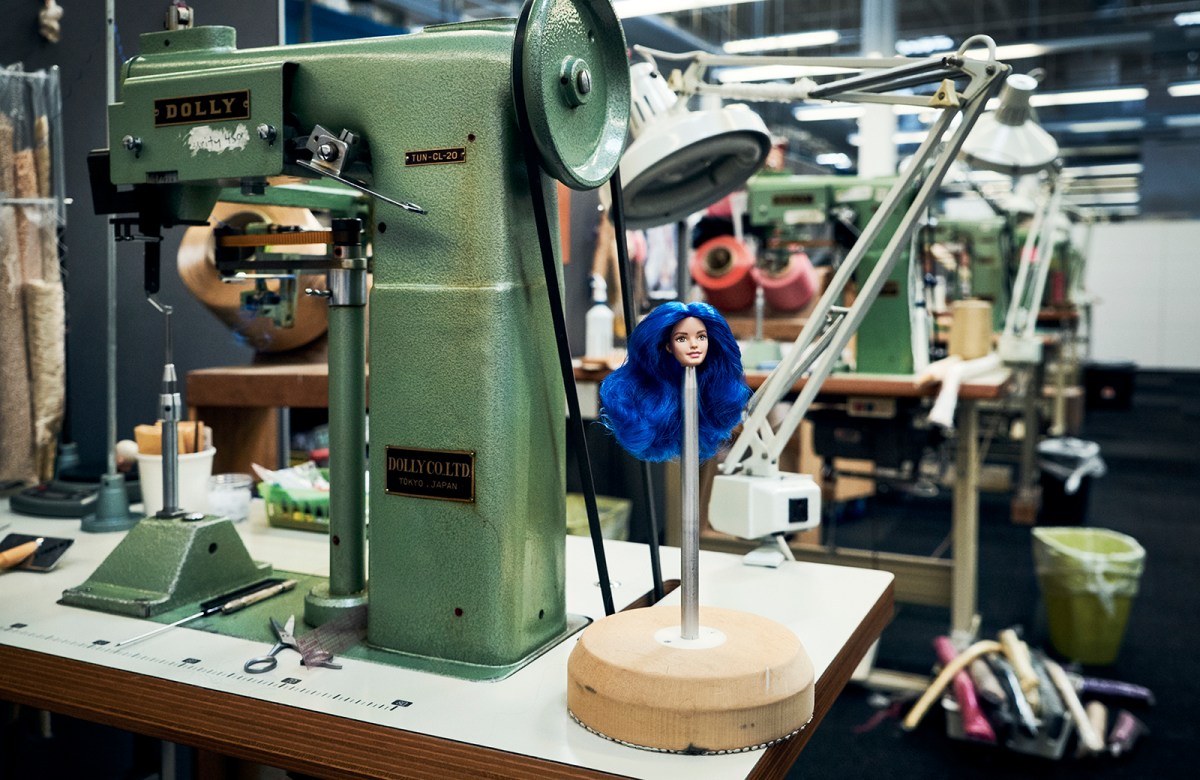
And despite the girls who thought the curvy doll looked fat, most of the kids in the groups I observe cull their favorite doll or the doll that looks nearly similar them based on hair, not trunk shape. A curvy, blue-haired doll that many girls dub Katy Perry is by far the most popular. Simply when asked which doll is Barbie, the girls invariably point to a blonde.
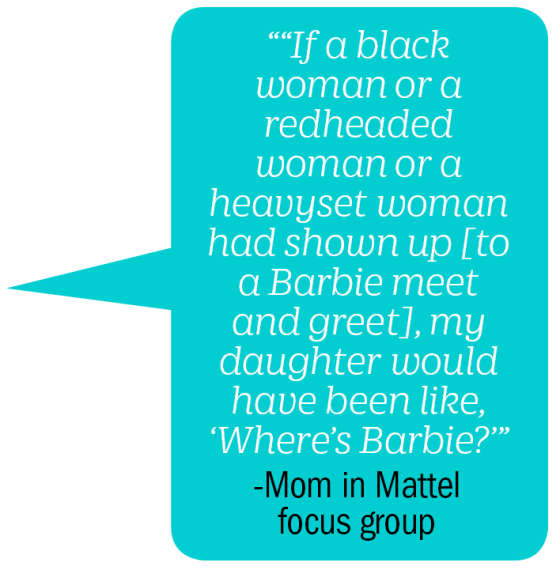
The thought that all these different dolls—none of whom look alike—can all exist Barbie is disruptive to moms as well. "I brought my daughter to a Christmas-tree lighting with Santa and Barbie the other twenty-four hours," says a mom in one of the focus groups. "If a black woman or a redheaded woman or a heavyset woman had shown upwards, my daughter would take been like, 'Where's Barbie?'" If Mattel takes away everything that makes Barbie an icon, is she still that icon? Companies work decades to create the sort of make recognition that Barbie has. When people around the world close their eyes and call up of Barbie, they run across a specific trunk. If that body changes, Barbie could lose that status. Worse still, some customers may not like the new version. Also bad for them.
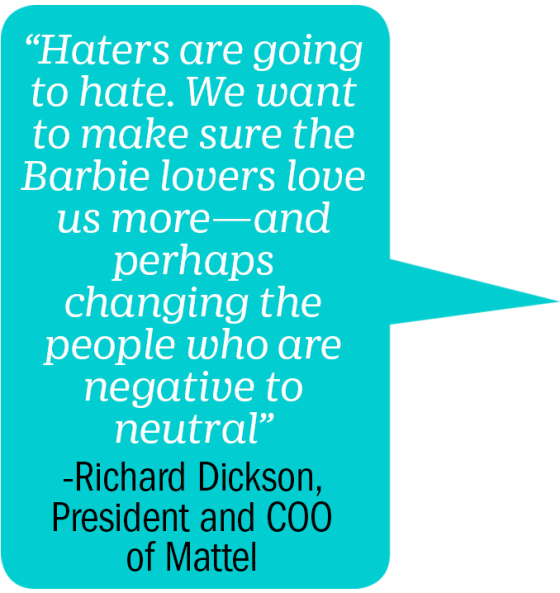
"Ultimately, haters are going to hate," Dickson says. "We want to brand sure the Barbie lovers dear us more—and peradventure irresolute the people who are negative to neutral. That would be squeamish."
Source: https://time.com/barbie-new-body-cover-story/
0 Response to "Barbie Dolls That Have Their Own Babies That Give Birth to Them but Are Aloe Really Low Prices"
Post a Comment